
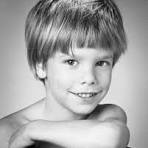

Why did I begin writing a novel about a kidnapping? Because I’m a mother. Because of an event in the Chicago suburbs that haunted me, haunted anyone with a heart, a soul.
The child’s name was Jeannine, home with a cold, kidnapped…but I don’t need to write more…I being blessed and home that day, raising our two daughters, the event now haunting me…probably more than it should have. But eventually, to deal with my thoughts, I began to write. Years later, I have written three novels, parts of one recently published. I have also written a collection of stories, A Mother’s Time Capsule…because that’s what writers do. We take our hopes, and our fears, and we write…this blog, newspaper articles, essays.
And there is my one novel, that will always make me think of Jeannine…my mother purchasing for me an Isabel Bloom statue…it’s a father reading to his child, crafted and sold to honor Jeannine through the Chicago library system. My mother knew I could not let go of Jeannine’s story, I researching the thought processes others used to deal with the disappearance of their children. And I read stories, viewed other-worldly images, these being connections that offered peace to the family of the victims…maybe to me.
And there is always time….I finished a version of my novel, tried to publish it…then much later, we moved to California, our children grown, writing now my full-time endeavor. Yes, I had three novels in manuscript boxes, unpublished. Yes, I still had work to do.
AND THERE WAS ETAN PATZ
His a story that never ended, his body never found. One day, Etan’s parents said he could now walk the few New York city blocks from his home to his school. Etan did. And Etan disappeared.
The New York Times…on the morning of May 25th 1979, Etan went missing and was never found. He was six years old. His parents considered him old enough to walk to school. Etan’s disappearance affecting and changing the way parents allowed their own children to get to school. One parent no longer let his son take the bus, but suddenly suggested that the two ride a bike to the boy’s school. “I was so young that I didn’t put the two together,” the now grown man said recently.
And there were parents across the country who read the papers every day, hoping Etan would be found, would be safe. Unknowing is often worse than knowing. But there was never an answer…my story hovering there.
AND I WAS WRITING AND WE MOVED
While living in Des Moines, Iowa….I was home for my son, home for my writing. (I did editing for Meredith Corp, worked at the Des Moines Health Department.) I also wrote three novels, the first still unpublished…my kidnaping story. Because when you become obsessed with an issue, you find yourself writing about it. Then and later, kidnaping haunted me.
Then time passed, and there’s the Internet, information a keystroke away. Want to learn about Etan…do a search. Want to have someone with knowledge of writing, publishing…take an online workshop, join the Women’s Fiction Writing Association, a new world of writing now available to teach, encourage. And be grateful….you’ve been working toward this very goal.
Then one day, after your writing instructor, Donald Maass, has read part of your novel-in-progress, he mentions Etan Patz. At the time, Maass lives in New York City…and there is nothing more important to writers than having your teacher, your reader, being MOVED by your words, the emotions of your scene. Donald Maass was: the kidnapper in my story forcing a painful haircut on the child she has taken…because she wants the child to now look like a boy. The scene graphic. So I asked Mr. Maass in a teaching session if I had gone too far with the cruelty. He said NO, and in his comment to me, he mentioned Etan. Of course he did. Every New Yorker knew that story.
SOME MORE GOOD ADVICE
Too often writers think of place as setting, something objective that the writer needs to describe. But place may be etherial, may haunt a story, exist apart from it, unchanging, indifferent. Place comes alive, not because of how it looks to a reporter (we, the writers), but how it affects the character. Thus Maass liked the broken down house where the kidnapper kept the child; also the change in weather that made the rescue scene more complicated.
He also addressed the issue of creating a character, but never abandoning that character.
“Characters don’t arrive as blank slates. …there is hardly a character we meet who does not already carry a wound, a burden, or arrive in a state of paralysis. In some novels, recovery is not the end result, but instead the entire body and point of the story…more generally though, characters are people who are explained by their psychology.”
Yes, within the creative process, characters often spring to life, and we often really don’t know where they come from, or why we suddenly are creating them. And we do begin to consider this as they grow on the page, inhabit the list of character attributes Maass once provided: values, dark fears, public face. And let me add: past wounds, mistakes, losses, fears.
Writing should be visual, so that when I reread my work-in-progress, I should see again the place where the kidnapping takes place; the faces of the kidnapper, the innocent child. But what I might see is the statue dedicated to Jeannine, thus finding it necessary to ground myself in the scene, because if it is strong enough to arouse my emotions, then I can walk away, always grateful for teachers like Donald Mass…and also saying a prayer for Etan and Jeanine.
4 Responses
Gosh, I remember the Patz story…. it’s been a long time since I’ve thought of him.
Thanks, Carol. He has haunted me and is the reason for my first novel. Beth
Oh, I remember the story of poor Etan, living in the tri-state area. So haunting. Apparently, decades later it turned out to be a man who worked at one of the grocery stores who lured him inside. So sad and yes, the stuff of novels.
Thanks for reading and writing, Laurie.The true stories in my post were the reason I sat down and began writing When The Cottonwoods Blew, which has undergone many changes and even titles. But I believe in this story and hope to get it published soon. Thanks again, Beth